
Problem Solving
Understanding should come before action.
For people, teams and organisations who do not want to stack solutions faster, but want to understand more carefully what a situation is really asking.
Problem Solving helps leaders, professionals, teams and students work more independently with situations that do not become clear by themselves. Not by following a fixed step-by-step method, but by looking more carefully, choosing more thoughtfully and acting with better judgement.
For readers who want to engage with the ideas
hands-on and learn through practice.
Worldwide available here.

For the reflective reader who wants to explore the ideas in depth before putting them into practice.
Worldwide available here.
In brief
Much work begins with a problem that has already been named.
We need more ownership.
The collaboration needs to improve.
Our strategy needs to land.
People need to learn to work differently.
This project is stuck.
We need a training programme.
We need to decide faster.
Something really has to happen now.
Sometimes that first formulation is right. Often, it is mainly the beginning of the inquiry.
Problem Solving helps avoid working too quickly on the wrong problem. We examine what is going on, who experiences the problem, which assumptions are already present in the question, which solutions may have been chosen too early, and what first needs to be understood before action becomes wise.
For Living Motion, Problem Solving is both an entry point in its own right and an underlying basis for our work around strategy, leadership, learning and development.
Three ways into this page
You can read this page from a problem or question in your own practice. Then you will find language for looking more carefully at what is going on, and possible ways to work with Problem Solving in a team, organisation, project, learning setting or professional role.
You can also read this page from one of the books: Solving the Right Problem or The New Art of Problem Solving. Then you will find how the books connect to our wider practice, and how the thinking in them can be used with real questions.
Or you may be looking for the reader resources connected to the books. Those materials are available separately, so you do not need to search through the whole page to find them.
Two books, two ways in
The two books on this page offer different ways into the same field of work.
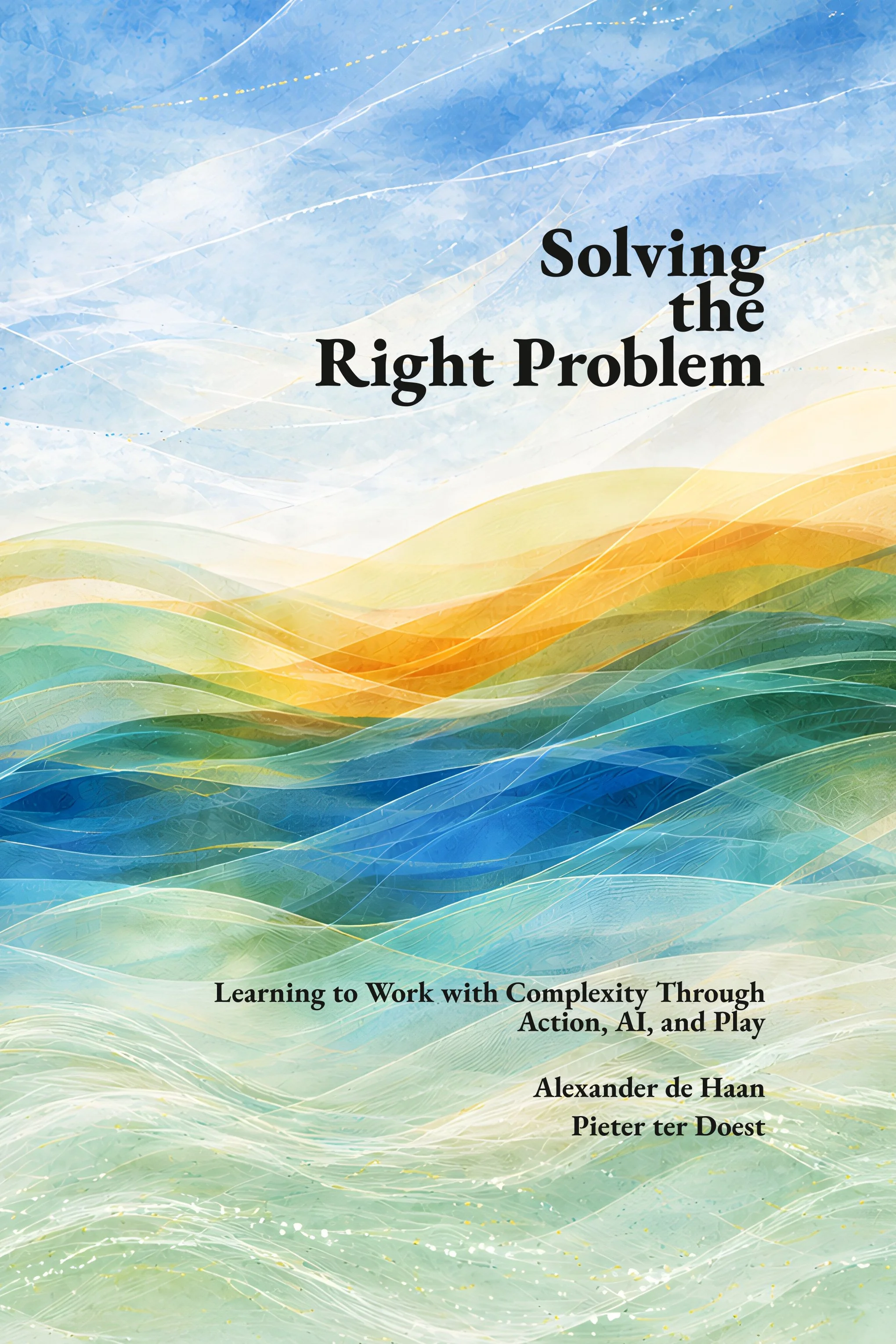
Solving the Right Problem is the most practical of the two. It is written as a workbook for people who want to work with their own project, team question or professional issue.
The New Art of Problem Solving is more reflective in tone. It explores the changing landscape of Problem Solving in a time when AI can think along, accelerate, summarise, organise and suggest alternatives.
The books can be read separately. They also belong together.
One helps you work directly with your own situation.
The other helps you deepen the way you think about Problem Solving, human judgement and responsibility in an age of increasingly capable technology.
Solving the Right Problem
Solving the Right Problem is a hands-on workbook for people who want to become more careful and capable in working with complex problem situations.
It helps readers avoid solution rush, explore different perspectives, make assumptions visible, distinguish between problem space and solution space, and choose more carefully what a next step could be.
This book fits readers who want to work directly with their own problem, project or professional situation.
View or order the book here.
The New Art of Problem Solving
The New Art of Problem Solving is a reflective book about Problem Solving in a time of AI, serious games, modelling and increasingly powerful tools.
The book does not treat technology as a replacement for human thinking. It asks what becomes more important when tools can generate options, simulate outcomes and produce answers faster than before.
The answer is not less human judgement, but more careful human judgement.
This book fits readers who want to explore the way of looking behind Problem Solving before applying it in practice.
View or order the book here.
A professional capacity
Problem Solving is not a fixed method that you apply once a problem is on the table.
It is an underlying professional capacity.
Just as reading for understanding is more than recognising words, and writing well is more than making sentences, Problem Solving is more than coming up with solutions.
It is the capacity to work more independently and carefully with situations that are not yet clear.
That may mean:
seeing more carefully what is really going on;
distinguishing between a symptom, a wish, a solution and a problem;
examining which assumptions are already present in the problem formulation;
making room for different perspectives;
understanding what the context makes possible or difficult;
choosing small movements that help you learn more;
acting without making the situation smaller than it is.
Problem Solving does not help people have an immediate answer to everything. It helps them work more responsibly with uncertainty, tension and complexity.
Where this often starts
Problem Solving often begins when something keeps returning.
A decision has been made, but the same tension comes back.
A strategy has been formulated, but people still struggle to act with it.
A team has talked about collaboration many times, but the pattern remains.
A learning solution has been requested before it is clear what needs to be learned.
A project has been analysed, but still does not move.
An AI tool produces answers, but it is not yet clear what question should guide the work.
In such situations, more effort is not always the first thing needed.
Sometimes the first task is to understand the situation differently.
Not straight to the first solution
A first solution can be useful.
It gives direction. It reduces uncertainty. It helps people feel that something can now be done.
But in complex situations, a first solution can also come too early.
It can close the conversation before the situation has been understood. It can make one perspective dominant. It can turn a symptom into the problem. It can make people work hard on something that was never the main issue.
Problem Solving does not reject action.
It asks that action be grounded in better understanding.
AI, judgement and responsibility
AI can be a powerful thinking partner.
It can help generate options, compare scenarios, summarise material, surface patterns, support modelling and challenge assumptions.
But AI cannot decide what ought to matter.
Every problem definition contains choices. What counts as better? What are we trying to protect? What are we willing to risk? Which consequences are acceptable, and which are not?
These are not only technical questions. They are questions of judgement.
That judgement remains human.
Technology can inform our thinking. It can widen the field of view. It can make alternatives visible. But it cannot take responsibility for the objective we choose, or for the consequences of the actions we take.
In complex situations, Problem Solving is therefore not only analytical. It is interpretive, practical and responsible.
The Problem Manager
As tools become more capable, the quality of problem formulation becomes even more important.
This is where the idea of the Problem Manager becomes useful.
The Problem Manager is not the person with the answer.
Not a hierarchical authority who decides alone.
And not simply a facilitator who makes sure everyone speaks.
The Problem Manager helps safeguard the quality and responsibility of Problem Solving itself.
That means asking questions before solutions are selected:
What are we really trying to address?
Who is affected?
Which assumptions are we making?
What does “better” mean in this situation?
Are we using AI to think more carefully, or to close the inquiry too quickly?
Are we optimizing the right objective?
Which perspectives are missing?
What are we no longer seeing because agreement has arrived too fast?
This is not about control.
It is about stewardship.
In environments where action becomes easier and faster, someone has to help protect the quality of how the situation is framed, explored and acted upon.
Under strategy, leadership and learning
Problem Solving is not only relevant when something is explicitly called a problem.
It also lies underneath much of our work around strategy, leadership, collaboration, learning and development.
A strategy question often contains an unexamined problem definition.
A leadership question often contains assumptions about responsibility, ownership or behaviour.
A learning question often starts with a requested form before the development question has become clear.
A collaboration question often hides different experiences of the same situation.
Problem Solving helps us not move too quickly into the solution space.
It helps leaders, teams and professionals stay with the question long enough to see what kind of work is actually needed.
How we look and work
We do not begin with a fixed format.
We begin by looking at the situation.
For example:
What is being named as the problem?
Who experiences it as a problem?
Who does not?
What has already been tried?
Which solution is already hidden in the question?
What keeps returning?
What would change if we looked from another perspective?
What role do data, models, AI or serious games need to play here?
What can be learned through a first small movement?
Who needs to remain responsible for the work?
The form follows from the question.
Sometimes that leads to a work session, team session, workshop, guided inquiry, small learning group, educational programme, online or hybrid work, or a longer trajectory.
But the form comes later.
First we try to understand what kind of problem work is actually needed.
Working with Problem Solving
Working with Problem Solving can take different forms.
Sometimes it starts with a working lecture: a focused session that introduces a way of looking and helps people recognise where solution rush, hidden assumptions or unclear problem definitions show up in their own work.
Sometimes it becomes a workshop or work session around a real question. Then we do not work with a generic case, but with a situation that participants need to understand and handle more carefully.
Sometimes it takes the form of a team or leadership session. This can be useful when a group keeps moving around the same issue, without quite getting through it. The question may involve collaboration, ownership, strategy, decision-making, priorities, roles or recurring tension in the work.
Sometimes Problem Solving becomes guidance in a project, programme or change effort. Then it is not one session, but a way of keeping the work sharper while action is already underway. We look along at moments where choices are needed, assumptions become visible, solutions become dominant too quickly, or the problem changes as people work with it.
Sometimes it becomes a small learning group or professional class. Participants bring their own cases and develop their capacity to work with problem definitions, perspectives, assumptions, modelling, AI, judgement and responsibility.
Problem Solving can also have a place in education, training or professional development. Not as a separate step-by-step method, but as a capacity that helps people work more independently with questions in their field, organisation or role.
Much of this work can also take place online or in a hybrid form, when real contact and feedback remain possible. People bring in their own work, we can look together at what happens, discuss assignments, work through examples, use short explanation videos, and use online forms or serious games when they help the learning.
Online work is then not a distant product, but a guided way of working with real questions or with the capacity to work with problems more carefully.
The exact form follows from the question. We do not begin with a fixed session format.
For readers of the books
The books can be read on their own.
They can also be used in education, professional development, guidance, work sessions, team settings or personal practice.
If you come from one of the books, you may want to work further with:
a problem formulation you are not sure about;
a project that keeps getting stuck;
a team question;
a chapter or exercise you want to connect to your own practice;
a situation where AI is helping, but also making closure too easy;
a question about how to use the ideas in education, leadership or organisational work.
There are also a few reader resources connected to the books, such as worksheets and prompts.
They are meant to support careful thinking, not replace the work of understanding the situation.
A good starting point is one situation that is still alive for you. Not a perfect case, and not a solved one. Use the materials to slow down, explore perspectives, make assumptions visible and begin seeing more clearly what kind of problem you are actually dealing with.
When working with Problem Solving fits
Working with Problem Solving fits when there is a real question that does not become clear by itself.
For example, when a problem keeps returning, when earlier solutions have changed too little, or when people suspect that the problem itself needs to be understood more carefully.
It fits when people are willing to examine their own assumptions, include different perspectives, and work further after a conversation, session or trajectory.
It also fits when there is pressure to act, but enough room to ask whether the first problem definition is really the one that should guide the work.
When it fits less well
Working with Problem Solving fits less well when the main request is for a quick answer, a fixed method, a ready-made tool or confirmation of a problem definition that may not be questioned.
It also fits less well when the solution has already been chosen and the real question is only how to get people to accept it.
Then the work becomes too narrow.
Problem Solving requires enough room to investigate what is going on before the next answer is fixed in place.
Bring a question worth understanding
Problem Solving often begins at the moment when solving is no longer enough.
Maybe much has already been tried. Maybe there is pressure to move on. Maybe a solution is already on the table, but it still feels as if the problem has not been understood well enough.
That can be a good moment to get in touch.
Not because we take the problem over.
And not because every question automatically needs a trajectory.
But because a first conversation can help clarify whether Problem Solving can contribute something here.
We can look together at whether there is enough question, ownership and room to examine the problem before the next solution is fixed.