When collaboration starts to feel difficult.
When you sense it could be better.

Many teams notice that working together takes more and more effort.
Meetings pile up, coordination drains energy, and even with the best intentions, things begin to feel strained.
Not because people aren’t willing, but because what makes collaboration so heavy often lies in the team dynamics — and those are rarely clearly visible.
How It Works
This is not a training or a lecture. It’s a shared journey.
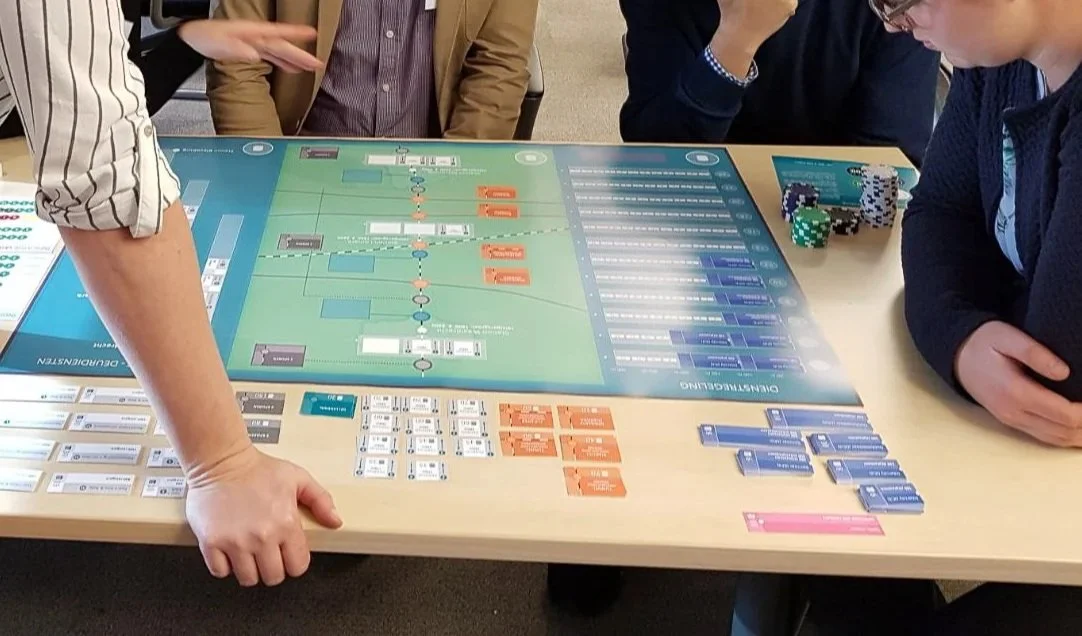
We begin with a collaborative activity, often a Serious Game, that requires the team to work together toward a shared goal. As the group navigates the challenge, natural behaviors emerge: who leads, who hesitates, who adapts, who resists.
The activity may involve time pressure, complex decisions, or conflicting priorities, whatever reveals real dynamics.
At key moments, we pause to reflect together:
What just happened?
What helped? What got in the way?
What might we try differently?
Then we go back in, applying a new strategy, testing it, and seeing what changes.
The result is a loop of awareness, experimentation, and shared growth. No abstract theories. Just your team, working with itself.
New ideas to try out
Many teams keep returning to the same explanations: we need to communicate better, we should make clearer agreements.
Generative AI helps teams move beyond those familiar conclusions. It generates unexpected proposals, alternative roles, different forms of collaboration, or possible sources of friction.
By loosening fixed explanations, Generative AI opens up new perspectives: other ways of aligning, deciding, responding, or organizing.
These suggestions are immediately tested in the game and explored further through reflection.
Why This Is Different
This isn’t ‘fun teambuilding’. And it’s not a static assessment either.
It’s a living process where your team:
Chooses what to focus on
Designs its own strategy for change
Tests that strategy in real time
Learns through doing, not just talking
It’s serious, but playful.
Structured, but open.
Deep, without pressure.
This is precisely what makes visible what a team keeps in place beneath the surface.
What It Can Focus On
The session structure stays the same, but the focus can shift depending on your context:
Communication dynamics (tone, clarity, timing, silence)
Trust and vulnerability (psychological safety, withholding, speaking up)
Decision-making (fast vs. slow, top-down vs. group-led)
Role negotiation (initiative, contribution, invisible work)
Handling tension (conflict styles, avoidance, resolution)
Sometimes, multiple of these unfold together. That’s part of the richness.
Ideal For
Teams that want to grow and are willing to look at what is happening beneath the surface of their collaboration
Groups in transition: new people, new leadership, a new phase
Teams that have already done trainings, but are not looking for yet another model and want to experience something real
Leaders who want to step back and observe the system they are part of
What You Leave With
A shared experience that reveals what’s really going on
Language and insight grounded in your team’s own words
A plan, not handed to you, but created by you
A felt sense of trust, awareness, and possibility